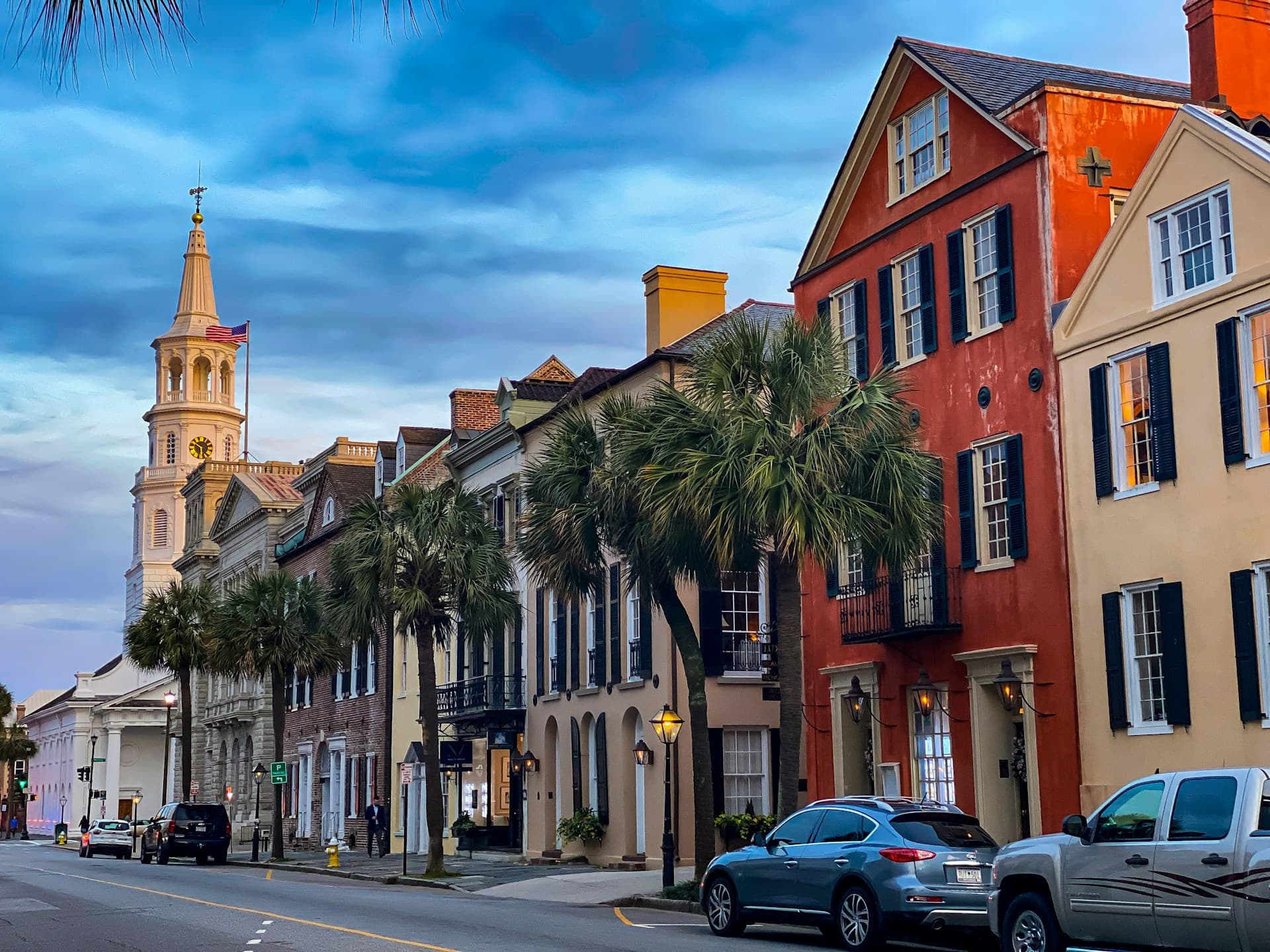
Isle of Palms is a seven-mile barrier island ~12 miles northeast of downtown Charleston, with ~4,440 homes and ~6 miles of Atlantic shoreline. This guide covers the non-resort residential island — the Front Beach district, Ocean Boulevard corridor, Palm Boulevard interior, and every non-gated condo and cottage outside the Wild Dunes gate, which has its own guide.
There is no island-wide HOA; fees apply only at specific condo regimes and a few small communities. Flood-zone exposure runs from wave-action zones on the oceanfront (base flood elevations of 11–15 feet) through the standard interior floodplain (9–12 feet) to a handful of higher-elevation parcels outside the floodplain. Short-term rentals are licensed, uncapped, and cover ~29% of island parcels.
Property taxes fall under Charleston County District 24 at 236.2 mills (2025), with a 4% primary-residence ratio versus a 6% non-primary ratio producing a ~$10,400/year swing on a $1M home. The Isle of Palms Connector (SC 517) is the only fixed-span route from the island to the mainland — the alternate path via Breach Inlet to Sullivan's Island crosses the Ben Sawyer swing bridge — and summer-weekend backups on the Connector are a routine 3–4 miles.
Quick Facts
- Location: Barrier island, ~12 miles northeast of downtown Charleston
- Total homes: ~4,440 (island-wide, including Wild Dunes)
- Year-round population: ~4,362 residents (2024 ACS)
- Home styles: Lowcountry, raised beach cottages, elevated single-family, mid-rise condos
- Price range: $750K – $13M
- Median sale price: ~$1.8M (island-wide, 12-month)
- Median year built: 1985
- Island-wide HOA: None (building-level regimes only)
- Charleston County stormwater fee: ~$72/year per parcel
- Flood zones: VE 11–15 ft oceanfront; AE 9–12 ft interior; some Zone X
- Property tax district: Charleston County District 24 — 236.2 mills (2025)
- Schools (zoned): Sullivan's Island Elementary → Moultrie Middle → Wando High
- Short-term rentals: Licensed, no hard cap; ~29% of parcels licensed
- Bike Score: 60 / 100
- Distance to downtown Charleston: ~12 miles / 25–30 min off-peak
What makes Isle of Palms different from other Charleston beach towns?
Isle of Palms is the Charleston-area beach that still lets you rent out your house. Sullivan's Island, immediately south across Breach Inlet, prohibits short-term rentals and has tighter zoning — which is a big part of why its home values run roughly three times higher per square foot. Folly Beach, on the other side of the harbor, is smaller, cap-constrained, and draws a different buyer profile. Isle of Palms sits in the middle: a working beach town with a seven-mile beach, a resident base that actually lives here year-round, and a rental economy that makes second-home ownership financially rational for many buyers.
Sewee Camps, a Submarine, and a Veterans-Cottage Island
The island was seasonal Sewee territory for centuries before it was called "Hunting Island" and later "Long Island" on English maps. On June 29, 1776, British forces attempted to cross Breach Inlet to attack the American fortifications on Sullivan's Island; the crossing failed and the attack collapsed that day. On February 17, 1864, the CSS Hunley departed from near Breach Inlet and became the first submarine in history to sink an enemy warship.
J.S. Lawrence bought the island in the late 1890s, renamed it Isle of Palms, and built the resort trade around rail and ferry service from Mount Pleasant. By 1912 James Sottile was operating a beach pavilion with a Ferris wheel. The ferry service failed financially in 1924, and the 1929 opening of the Grace Memorial Bridge between Charleston and Mount Pleasant shifted island access to automobiles.
The modern residential island traces to the mid-1940s, when J.C. Long's Beach Company acquired most of the undeveloped land and built postwar veterans cottages — two-bedroom, roughly 800-square-foot homes on concrete slabs, along with a low-cost all-concrete "ALCON" design. Those mid-century cottages are the bones of today's island, though many have been replaced or elevated since Hurricane Hugo made landfall on September 22, 1989 — a Category 4 storm with an ~11-foot surge that damaged essentially every structure on the island.
Hugo Reset the Price Structure
Hugo permanently reset Isle of Palms' price structure. Under-insured owners sold damaged lots, post-storm building codes drove up construction costs, and elevation requirements eliminated the affordable ground-level cottage format. More than thirty years later, the island-wide median sale is ~$1.8M, single-family medians run ~$2.15M, and oceanfront new construction regularly exceeds $10M. The October 2, 1993 opening of the Isle of Palms Connector (SC 517) — a direct bridge from Mount Pleasant — was the other piece of the modern equation, cutting the off-peak drive to downtown Charleston to ~25–30 minutes.
How much do homes cost on Isle of Palms?
Non-resort Isle of Palms homes range from roughly $750K for older cottages and small condos to more than $12M for new-construction oceanfront mansions, with a 12-month island-wide median sale price of ~$1.8M and an average near ~$2.19M. Inventory has been running ~80–85 homes for sale with ~60 days on market and ~4.9 months of supply — a deliberate pace for a Charleston market.
Three Single-Family Tiers
Entry / value tier (~$750K – ~$1.5M): Older 1960s–1980s raised cottages and ranches on interior Palm Boulevard and cross-street lots, plus older condos. A buyer here is often paying for the lot and the island address more than the structure. Many of these homes need substantial updating, and some still carry pre-1989 construction that predates modern wind and flood codes.
Mid-range (~$1.5M – ~$3M): The heart of the resale market — renovated or rebuilt single-family homes on Palm Boulevard and the numbered avenues, marsh-front and waterway homes, and well-appointed second-row properties a block or two off the beach. Typical product: 2,000–3,500 square feet, 0.2–0.4 acre lots, built 1970s–1990s and updated.
Premium / oceanfront (~$3M – $13M): The oceanfront stretch of Ocean Boulevard — locally called "Millionaire's Row," a marketing label, not an HOA or municipal district — is where the top of the market lives. New-construction elevated homes with deepwater docks, 5,000–7,000 square feet, and lots up to ~1.8 acres. Direct-oceanfront new construction at the top end trades in the $9M–$13M range.
Five Loose Character Zones Inside the Island
Isle of Palms is not organized into named HOA subdivisions the way a mainland master-planned community is. Locally, agents talk about five informal character zones:
Front Beach district (Ocean Blvd, 10th–14th Avenue): The commercial hub — the Windjammer, restaurants, retail, municipal parking, and the entrance to Isle of Palms County Park. Condo buildings (Sea Cabins, Oceanside Villas, Dunescape, Ocean Palms, Ocean Inn, the Palms Oceanfront Hotel, 1140 Ocean Blvd) cluster here. Highest-density, most tourist-oriented stretch of the island.
Residential Ocean Boulevard corridor: From 1st Avenue to ~41st Avenue outside the Front Beach block, the oceanfront mixes single-family homes, cottages, and smaller condo buildings. The southern end near Breach Inlet holds older cottages on smaller lots; mid-island oceanfront carries the highest-value trophy properties.
Palm Boulevard interior corridor: The main east-west spine. A mix of second-row single-family homes, duplexes, and older ranch houses. Quieter than Ocean Boulevard, with easier parking and lower flood-zone exposure.
Waterway / Hamlin Sound side: Marsh-front and creek-front homes on the Intracoastal Waterway side, often with private docks. Flood zones are typically AE rather than VE, and the sound side feels more residential and less rental-heavy than the oceanfront.
South end near Breach Inlet (1st–10th Avenue): Older cottages on smaller lots with close access to Sullivan's Island across the inlet. Popular with full-time residents and long-held family properties.
Beachside and Pavilion Place — Two Small HOA Enclaves
Two non-resort communities run their own HOAs rather than operating as single-building regimes:
- Beachside is a private community of 58 cottages off Palm Boulevard, with its own pool and tennis court. Confirm current HOA dues in the resale package.
- Pavilion Place is a six-home enclave in the 1001–1003 Ocean Boulevard range with a shared pool. Dues cover fence, landscaping, and lawn maintenance; confirm the current amount in the resale package.
Selling in Isle of Palms?
We track Isle of Palms inventory, buyer demand, and pricing shifts. Get a confidential valuation and a practical strategy for timing, prep, and pricing.
What is it like to live on Isle of Palms?
Living on Isle of Palms year-round means a golf-cart beach town for eight months and a tourist economy for four. The rhythm is seasonal, and buyers expecting continuous year-round energy should understand the math before writing an offer.
Seasonality Is the Defining Fact of Island Life
Only ~36% of Isle of Palms housing units are occupied by year-round residents — the rest are second homes, short-term rentals, and seasonally occupied properties. Year-round population is ~4,362; summer beach-season counts run in the 12,000–20,000 range on peak holiday weekends.
Day-to-day, this means intense summer weekends with full parking lots, Connector backups, and restaurant waits — and quiet winters. Not empty, just quiet. The Recreation Center on 24th/28th Avenue runs year-round adult and senior programs that act as the social spine in the off-season. Full-time residents learn to love November through March; visitors typically only see the July version of the island.
Golf Carts Are the Local Transportation
Street-legal golf carts are the default way to get around the interior. South Carolina requires registration, insurance, and a licensed driver, with daylight-only and ≤35 mph road restrictions. Isle of Palms adds its own layer: golf carts are banned on Palm Boulevard (the main spine) and on the IOP Connector. Legal routes run the residential side streets and the signed cart paths the city has designated over the past several years. Buyers planning to use a cart as primary transportation should map the route in advance.
One Grocery Store, a Front Beach Dining Core, and a Live-Music Landmark
Harris Teeter at 1513 Palm Boulevard is the only on-island grocery store. Longtime residents still sometimes call it by its former "Red and White" name. For anything beyond a grocery top-off — specialty retail, big-box, medical appointments — residents cross the Connector to Mount Pleasant.
Island dining concentrates in the Front Beach district and along Palm Boulevard: Coda del Pesce (upscale Italian with ocean views), Long Island Cafe, Acme Lowcountry Kitchen, The Boathouse, The Dinghy, and the Windjammer — a beachfront live-music venue open since 1972 that hosted early Darius Rucker and Hootie & the Blowfish sets and was rebuilt after Hugo.
Isle of Palms County Park at 1 14th Avenue is a Charleston County Parks facility with 445 parking spaces, restrooms, changing areas, outdoor showers, seasonal lifeguards, a playground, and concessions. It's the primary managed beach access on the island, alongside 57 numbered public access paths.
Dogs, Turtles, and the Ordinances Residents Actually Follow
Isle of Palms is dog-friendly but strictly regulated. Off-leash hours shift with the season. April 1 – September 14, dogs are allowed off-leash on the beach only between 5:00 and 9:00 AM. September 15 – March 31, off-leash runs 4:00 PM to 10:00 AM. Outside those windows, dogs must be leashed, even in the water. The Bark Park is at 29th Avenue behind the Recreation Center.
Sea-turtle nesting season runs May 1 – October 31. Oceanfront property owners must shield or turn off exterior lights facing the beach from sunset to sunrise under Sec. 5-4-17 ("Lights Out for Loggerheads"). Beach furniture, tents, and equipment must be removed nightly during nesting season under Sec. 5-4-15 — anything left overnight gets removed and disposed of. Federal penalties for harming a nest or hatchling can reach $25,000 and a year in prison.
Other resident-facing rules: dune protection under Sec. 6-2-23, marsh-buffer setbacks under Sec. 5-4-18, and tree-removal permits under Sec. 5-4-61 with elevated protection for "Historic" and "Significant" trees. The island also bans single-use plastic bags, straws, Styrofoam containers, balloons, and smoking/vaping on the beach.
Considering Isle of Palms?
We can help you compare sections, flood exposure, schools, and the tradeoffs that do not show up in the listing photos.
How far is Isle of Palms from downtown Charleston?
Isle of Palms is ~12 miles from downtown Charleston, a 25–30 minute off-peak drive via the Isle of Palms Connector (SC 517) and I-526, or 30–35 minutes via the older Ben Sawyer Bridge (SC 703) through Sullivan's Island. Charleston International Airport is ~22 miles / ~35 minutes via I-526.
The Connector story matters to buyers. The bridge opened October 2, 1993 and has never had a toll. During peak summer weekends and holidays, backups approaching the bridge regularly extend 3–4 miles, pushing drive times to 45–60 minutes just to get across. The city is studying an AI-enabled traffic-light system at Palm Boulevard and the Connector, restriping for two outbound lanes during peak outflow, and expanded beach shuttle service. The Connector is also the primary hurricane evacuation route — SC 517 east to US 17, then westbound toward I-26 and Columbia during contraflow. Drawbridges across the Charleston region lock down to boat traffic at 25 mph sustained winds; high-profile vehicles are advised off exposed bridges at 30 mph (Condition Yellow); exposed bridges are deemed unsafe for public travel at 40 mph (Condition Red).
There's no hospital on the island. East Cooper Medical Center and Roper St. Francis Mount Pleasant are both in Mount Pleasant, ~8 miles from central Isle of Palms. Higher-acuity care means driving to downtown Charleston or North Charleston.
What schools serve Isle of Palms in Charleston County?
Isle of Palms sits in Charleston County School District (Moultrie Constituent District 2) and is zoned to three schools, all rated A on Niche and 9–10 on GreatSchools. The zoning has been stable through the district's 2019 rezoning.
| Level | Zoned school | Niche | GreatSchools | Notes |
|---|---|---|---|---|
| Elementary | Sullivan's Island Elementary | A | 10/10 | Coastal-environmental magnet with two wet labs |
| Middle | Moultrie Middle (Mount Pleasant) | A | 9/10 | Gifted & Talented; PLTW Gateway STEM |
| High | Wando High (Mount Pleasant) | A | 10/10 | One of SC's largest high schools; 26 AP courses; ~94% graduation rate |
Elementary students commute off-island to Sullivan's Island for Sullivan's Island Elementary — the zoned school sits across Breach Inlet. Middle and high schoolers cross the Connector to Mount Pleasant.
Lucy Beckham High School opened in Mount Pleasant to relieve Wando's overcrowding but is not zoned for Isle of Palms. Zoning can change — confirm with Charleston County School District before buying on school assumptions.
What are the HOA fees on Isle of Palms?
There is no island-wide HOA on Isle of Palms. Outside the Wild Dunes gate, a single-family home is typically governed by the city code and the Charleston County stormwater fee (~$72/year). HOAs and regime associations exist at the building or small-community level. The non-resort regimes and communities with fees are:
| Building / Community | Structure | What the fee typically covers |
|---|---|---|
| Sea Cabins | 3-building oceanfront regime, 1300 Ocean Blvd | Cable, internet, water/sewer, pool, pier, exterior, master insurance, management |
| Oceanside Villas | Regime, 1400 Ocean Blvd | Insurance, cable, water/sewer, trash, exterior, pool |
| Dunescape | Gated 9-unit regime, 1006 Ocean Blvd | Pool, elevator, gate, grill area, parking, storage |
| Ocean Palms | Gated regime, 1010 Ocean Blvd | Water/sewer, pool, gate, elevator, common areas, exterior, trash, pest, liability + flood insurance |
| Ocean Inn | 20-unit regime, 1100 Pavilion Dr | Hazard insurance, water/sewer, cable, Wi-Fi, grounds |
| The Palms Oceanfront Hotel | Condo-hotel, 1126 Ocean Blvd | Interwoven with hotel management agreement |
| 1140 Ocean Blvd | Elevator oceanfront condo | Common areas, elevator, exterior |
| Beachside | 58-cottage HOA off Palm Blvd | Pool, tennis, trash, walking paths |
| Pavilion Place | 6-home HOA on Ocean Blvd | Fence, landscaping, lawn |
| 2000 Palm Blvd (fractional) | 1/13 deeded interest | Taxes, insurance, utilities, pest, landscaping, cleaning |
Fees move year to year, and several buildings assess different amounts by unit type. Confirm the current fee and what it includes in the resale package before you price the carrying cost — and in particular whether master insurance is bundled or billed separately as a per-unit annual assessment.
What "No HOA" Single-Family Ownership Gets You
For most of the island's single-family inventory, there is no HOA, no architectural review board, and no community-level assessment. Exterior changes are governed by the city's building code, design and zoning ordinances, tree-removal rules (Sec. 5-4-61), marsh buffers (Sec. 5-4-18), and — for any substantial renovation — the 50% substantial-improvement rule. That flexibility is one of the island's appeals for buyers coming from communities with restrictive review boards. It also means a neighbor can rebuild a modern elevated mansion next to your 1970s cottage without asking anyone's permission.
Financing for Non-Resort Condos
Financing a non-resort condo on Isle of Palms usually means a specialty lender, not a standard mortgage. No non-resort Isle of Palms condo projects are currently on the FHA approved list, and VA approval is limited to one Wild Dunes building. Most buyers end up with conventional lenders who are comfortable holding loans on buildings that don't meet Fannie Mae or Freddie Mac project guidelines — often called "non-warrantable" or "portfolio" projects. Tightened reserve-and-repair screens can knock older buildings with underfunded reserves out of mainstream financing, which is a real factor for pre-Hugo Front Beach product. South Carolina has no statewide condo reserve mandate; verify current reserve-study status in the resale package.
What flood zone is Isle of Palms in?
Isle of Palms is a barrier island, and essentially the entire developed footprint sits in or immediately adjacent to a FEMA Special Flood Hazard Area (SFHA) — the zones where flood insurance is required with a federally backed mortgage. The current effective map is the 2021 Flood Insurance Rate Map (FIRM). The zones you will see on Isle of Palms parcels:
| Zone | Where it appears | Base flood elevation (BFE) | Meaning for buyers |
|---|---|---|---|
| VE (coastal high hazard) | Oceanfront | 11–15 ft | Wave-action zone; strictest construction and highest flood premiums |
| AE (base floodplain) | Interior and waterway | 9–12 ft | Standard SFHA; flood insurance required with a federally-backed mortgage |
| AO (shallow flooding) | Interior low spots | — | Sheet flow / ponding in flat pockets |
| A (no elevation set) | Rare pockets | — | SFHA without an established elevation |
| X (0.2% annual chance) | Interior higher ground | — | 500-year floodplain — lower-risk, not risk-free |
| X (minimal risk) | Scattered interior parcels | — | Outside the SFHA |
Oceanfront Ocean Boulevard properties are predominantly VE 11–15 ft. Waterway and marsh-side homes are typically AE 9–12 ft. Some interior mid-island parcels sit in Zone X. For any specific parcel, use FEMA's Flood Map Service Center (msc.fema.gov) or check the current flood certification in the seller's disclosure package.
The Local Building Code Layer
Isle of Palms' flood-damage-prevention ordinance adds local stringency on top of the FEMA minimums. The three rules that shape ownership and renovation economics:
- Required build height (Design Flood Elevation, or DFE): The lowest finished floor on new construction and substantial renovations must sit either one foot above the FEMA base flood elevation or at 13 feet above sea level — whichever is higher. For much of the island that means a ~13 ft minimum finished floor.
- 50% Substantial Improvement Rule: If cumulative improvements or repairs reach 50% of the pre-improvement market value of the structure, the entire building has to come into full compliance. A cottage built at 10 ft can be forced to elevate to 13+ ft if a major renovation tips over the threshold. This is the rule that effectively forces teardowns on some older Isle of Palms cottages.
- Heightened-wave construction band (LiMWA): Buyers planning a new build on the AE parcels closest to the ocean should expect VE-equivalent construction cost. The city applies stricter wave-loading standards in this band — mapped by FEMA as the Limit of Moderate Wave Action (LiMWA) line.
CRS 25% Discount and What NFIP Actually Covers
Isle of Palms participates in FEMA's Community Rating System (CRS), and the city's current class earns a 25% discount on National Flood Insurance Program (NFIP) premiums for policies on SFHA parcels. On a ~$3,000 NFIP premium that's ~$750/year back.
Standard NFIP residential coverage limits are $250,000 for the building and $100,000 for contents (1–4 family). Condo buildings typically carry a master flood policy on the structure (the Residential Condominium Building Association Policy, or RCBAP), and individual owners may carry optional contents coverage. Primary-residence policies carry a $25/year surcharge; non-primary policies carry $250/year — a $225/year delta that compounds over a long hold.
Under the current FEMA pricing rules, premiums are driven by property-level variables like distance to water, first-floor elevation, and construction type — not zone label alone. Elevated homes generally price materially better than non-elevated homes in the same zone.
What the Insurance Stack Costs
The Isle of Palms insurance stack combines three policies: homeowners, wind/hail (often through the South Carolina Wind and Hail Underwriting Association — the "Wind Pool" — abbreviated SCWHUA), and flood (NFIP plus often a private excess flood policy for high-value homes). NFIP premiums under FEMA's current Risk Rating 2.0 methodology are driven by parcel-level variables — distance to water, first-floor elevation, construction type — rather than by zone label alone. VE oceanfront parcels generally price materially higher than AE interior parcels, and elevated homes generally price better than non-elevated homes in the same zone. Pull an address-specific NFIP quote during diligence rather than relying on a planning range.
For wind/hail, Charleston County Zone 1 (which covers Isle of Palms) is served by SCWHUA. SCWHUA took a 21.3% rate increase in June 2024 and an 8% increase in February 2026. The Wind Pool caps residential limits at $1.3M per risk, with a 3% named-storm deductible — a homeowner at the cap on a $2M home pays tens of thousands out of pocket per named storm before the policy responds, and private-carrier deductibles are often higher. Above the $1.3M cap, owners stack a private carrier on top. Pull address-specific quotes early in the diligence window.
Typical full-stack picture:
- Mid-island standard home, AE zone: homeowners + a wind/hail policy (often SCWHUA up to the cap) + an NFIP AE policy.
- Oceanfront VE zone: homeowners + a wind/hail policy (and often an excess-wind layer above the $1.3M cap) + an NFIP VE policy + a private excess flood policy over the $250K NFIP limit.
Totals move dramatically with elevation, construction age, carrier, and whether excess layers are required. Some insurers have pulled out of the South Carolina coastal market; what's quotable today may not be quotable next renewal. Pull an address-specific quote bundle early in the diligence window.
South Carolina Mitigation Credit
South Carolina offers a $1,500 sales-tax credit on retrofit supplies (hurricane-rated windows and doors, impact shutters, roof-to-wall connectors, reinforced garage doors) used to harden a legal residence. It stacks with insurer-side wind-mitigation credits. The credit is tied to legal-residence status; second-home owners should verify eligibility with a South Carolina Department of Revenue resource before counting on it.
Property taxes on Isle of Palms
Isle of Palms is Charleston County Tax District 24. The 2025 combined millage is 236.2 mills. South Carolina taxes primary residences at a 4% rate and non-primary / investment properties at 6%, and primary residences are also exempt from the school-operating portion of the bill — which is the largest single piece of the total. The two exemptions stack, which is why the 4% number ends up so much lower than a straight 4%-vs-6% ratio would suggest.
| Appraised value | Primary residence (4%) | Second home / investment (6%) | Annual delta |
|---|---|---|---|
| $1,000,000 | ~$3,748 | ~$14,172 | ~$10,424 |
| $2,000,000 | ~$7,496 | ~$28,344 | ~$20,848 |
| $3,000,000 | ~$11,244 | ~$42,516 | ~$31,272 |
The 72-Day Rental Threshold
South Carolina law sets a 72-day rental threshold for 4% primary-residence classification. Renting a primary residence for more than 72 days in a calendar year risks reclassification to 6% — on a $1M home at Isle of Palms millage, that's roughly $10,400 more per year. Second-home buyers typically plan for the 6% classification from the start; hybrid owner-occupant / part-time rental strategies need to be modeled carefully and tracked with the Charleston County Auditor.
Reassessment at Sale
South Carolina allows the county to reassess a property at the time of sale to reflect the purchase price, which can step up the tax basis on long-held properties appraised well below market. The seller's prior-year tax bill is often not predictive of what the buyer will owe the first year after closing.
Other Annual Line Items
- Charleston County stormwater utility fee: $72/year flat on every residential parcel, independent of 4% vs. 6% classification.
- Charleston County solid waste user fee: a separate flat per-parcel charge on the annual tax bill.
Exact amounts, exemptions, and credit factors vary by parcel. Pull the assessor's record for any specific property during diligence.
Short-term rentals, licensing, and the Sullivan's Island effect
Isle of Palms allows licensed short-term rentals, and the rental economy is a core part of island ownership math. Sullivan's Island, immediately to the south, prohibits STRs entirely — which pushes Charleston-market vacation rental demand onto Isle of Palms and helps drive both its rental rates and its appeal to second-home buyers. Voters rejected a proposed 1,600-license cap at a November 2023 referendum, and the city does not operate a hard numeric cap.
The License and the Fee
Every rental property — short-term or long-term — requires an annual rental business license from the city. The fee schedule runs $450 base for the first $2,000 of gross rental income and $4.60 per $1,000 above that. At typical coastal condo revenue levels the license lands in the ~$800–$1,000 range annually. Fees are due by April 30.
Occupancy, Vehicles, and the 24/7 Contact Rule
- Overnight occupancy: 2 per bedroom + 2 additional, capped at 12 total (excluding children under 2)
- At any time: twice overnight occupancy or 40 persons, whichever is less
- Vehicles: bedroom/occupancy formula, minimum 2
- STR parking permits: up to 4 per year at $15 each
- Owner/agent: 24/7 phone number on file; a designated representative must be able to be on site within one hour of contact
A rental license can be revoked after five founded complaints in a calendar year. Ordinance 2025-05 removed trash-can violations from the strike list and reset the complaint slate effective January 1, 2026.
The Lodging Tax Stack: 14% Total
Guests pay a combined 14% on short-term rental stays — state sales and accommodations taxes, plus Charleston County and City of Isle of Palms accommodations taxes and the city's beach-preservation fee. Mandatory cleaning fees are taxable. Airbnb and Vrbo typically collect and remit; self-managing owners are on the hook directly.
What the Median STR Earns
As of mid-2025, the island's short-term rental landscape looks like this:
| Metric | Value |
|---|---|
| Total residential parcels (island-wide) | ~4,627 |
| Total STR licenses | ~1,341 |
| Overall parcel licensing rate | ~29% |
| Condo licensing rate | ~55% |
| Single-family and other | ~22% |
| Median 2024 gross revenue | ~$60,000 |
| Mean 2024 gross revenue | ~$81,000 |
For a standard 2–3 bedroom condo or cottage, a ~$50K–$100K gross-revenue estimate sits within the island's median-to-mean band. Exceptional oceanfront properties with grandfathered high-occupancy licenses can earn multiples of the island median.
How to Stress-Test a Rental Pro Forma
Island-wide vacation-rental comps range widely. Occupancy on Isle of Palms typically runs near ~61% with an average nightly rate near ~$808; typical 2-bedroom units gross around ~$64,000/year and 3-bedroom units around ~$86,000. Anchor a pro forma on the municipal median of ~$60K and mean of ~$81K first, then layer in property-specific adjustments for bedroom count, oceanfront premium, and management model. The 72-day rental threshold also matters here — for an owner planning to live in the home as a primary residence while renting it, rental days over 72 can reclassify the property from 4% to 6% and wipe out the incremental revenue.
Infrastructure, utilities, and the septic question
Isle of Palms is a small city running its own water, sewer, and public works. A few infrastructure realities shape ownership:
- Water & sewer: Isle of Palms Water and Sewer Commission (IOPWSC). A volumetric rate adjustment took effect July 1, 2025. A new $26.2M hurricane-fortified wastewater treatment plant came online in 2024.
- Sewer vs. septic: Historically only about a third of island homes were on public sewer. Roughly 1,135 residential properties remain on individual septic systems — a little over 25% of the housing base. Septic concentration skews toward the Forest Trails service area on the west end (roughly 41st Avenue toward Breach Inlet, including Forest Trail and Duck Lane). Sewer/septic status is a meaningful diligence line item: inspection, pumping, and potential future connection assessments vary parcel by parcel, even within a single street.
- Electric: Dominion Energy South Carolina (sole provider). Beach-area homes with HVAC see meaningful summer usage spikes; pull the 12-month billing history from the resale package during diligence. Dominion has been physically elevating vulnerable switch houses on the island as storm-surge protection.
- Natural gas: Dominion gas is not universally available. Many homes are all-electric, with propane (buried tank) a common supplement for cooking or pool heat.
- Internet: Xfinity cable (near-universal, up to 1.2 Gbps) and AT&T Fiber (available on many streets, symmetrical 1–5 Gbps where built out). T-Mobile 5G Home, Verizon 5G Home, and Starlink are wireless alternatives.
- Trash and recycling: City Public Works runs once-weekly winter pickup (late August–May) and twice-weekly summer pickup (June 1–early September). Charleston County / Republic Services handles recycling every other week. Contractor debris, hazardous waste, concrete, and tires require county disposal.
- Fire/EMS: Island fire department with paramedic staffing. Resident concern about EMS staffing levels surfaced in early 2026 — no structural service gap, but staffing remains a live issue.
Stormwater and Drainage Projects
The island's biggest non-hurricane infrastructure limitation is stormwater pooling and king-tide nuisance flooding in low-lying streets — a function of flat topography, rising tides, and increased storm intensity. Two active projects are underway: Waterway Boulevard Multi-Use Path Elevation (raising berms and walls to lift flood protection from 6 feet to 7 feet, late 2025 through early 2026), and the Phase 4 Drainage Project at Palm Blvd 38th–41st Avenue (permitting completed 2025, heavy construction into 2026, to improve king-tide flow). Drainage ditches may not be used for yard debris disposal — blockages drive flooding complaints.
Beach Renourishment Is a Recurring Funding Question
Beach erosion is a structural feature of a barrier island with inlet dynamics at both ends. Major renourishment projects have run roughly every 6–10 years: 1983, 2008 (~$8M+, ~885,000 cubic yards), 2014–2015 (~280,000 cy), 2018 (~$11.8M, ~1.67M cy), and 2024–2025 (U.S. Army Corps of Engineers, ~600,000 cy). Next up is a ~$32M / ~2.2M cubic yard project planned for summer 2026; city council advanced it on a 7–2 vote in February 2026. Funding has been a recurring issue — a ~$10M gap surfaced in January 2026, a $1.5M state grant followed in March, and the city has discussed tax or fee increases to close the remainder.
For owners, this matters in two ways: beach width in front of a specific property varies with cycle timing, and funding mechanisms may show up as future city fees or assessments. Oceanfront owners considering shoreline armoring — seawalls, timber bulkheads, or fill — should know that the state regulates any construction inside the beach and dune zone through its Ocean and Coastal Resource Management office (OCRM). Unauthorized structures can come with suspended penalties that become payable if there's a later violation, so confirm any active OCRM obligation in the resale package.
Hurricane history and evacuation
Hurricane Hugo on September 22, 1989 is the island's modern storm baseline — a Category 4 landfall with ~135–140 mph winds and an ~11-foot surge on Isle of Palms. Every building on the island sustained at least some damage; Wild Dunes closed for nine months; the Windjammer was reduced to pilings and reopened June 21, 1990. Regionally, ~10,000 homes were destroyed or damaged. Post-Hugo rebuilding under updated elevation and wind-retrofit standards is the reason the current housing stock skews toward elevated Lowcountry and modern coastal.
More recent named storms — Matthew (2016), Irma (2017), and Dorian (2019) — each triggered gubernatorial evacuation orders, produced beach erosion and localized surge flooding, but did not repeat Hugo's level of structural loss.
Evacuation Timing and the Single Bridge Off the Island
South Carolina coastal evacuations are ordered by the Governor. The state's staged timeline anticipates a go / no-go decision around 24 hours before expected impact, with the evacuation itself taking 48 hours or more from order to completion. When the state activates I-26 westbound contraflow — both directions flowing inland — it happens by executive order, not local call. East Cooper residents use SC 517 (the Isle of Palms Connector) to US 17 — right lane to US 17 north toward the designated inland route; left lanes to I-526 and onto I-26 westbound.
Because the IOP Connector is the only fixed-span route to the mainland (the Sullivan's Island alternate crosses the Ben Sawyer swing bridge, which locks down in high winds), bridge-safety windows matter. Drawbridges lock down to boat traffic at 25 mph sustained winds; high-profile vehicles (RVs, box trucks, trailers) are advised off exposed bridges at 30 mph (Condition Yellow); exposed bridges are deemed unsafe for public travel at 40 mph (Condition Red). Waiting until winds reach the 30–40 mph range effectively eliminates safe use of the Connector. On Isle of Palms, leaving early is a bridge-safety decision tied to that single all-weather mainland route. Re-entry after a storm is a local decision — Charleston County's Re-Entry and Security Plan converts evacuation traffic-control points into re-entry control points, and authorities may require credentials, dash passes, or curfews depending on storm impacts.
Crime and safety
Isle of Palms grades A- on AreaVibes and C+ on Niche. Violent crime runs ~137–164 per 100,000, well below national averages. Property crime runs ~1,100–1,325 per 100,000 — a tourist-beach-town pattern tied to rental turnover and seasonal population surges.
Coyotes have become a salient 2026 community concern after a dog was killed in March and multiple sightings were reported, particularly on the west-end Forest Trails blocks. Pet routines at dawn and dusk, trash discipline, and neighborhood awareness are practical issues in a way they are not on most mainland neighborhoods.
Is Isle of Palms a good place to live?
Isle of Palms works exceptionally well for some buyers and genuinely doesn't for others.
Who Isle of Palms Fits
- Second-home buyers who want a rentable beach property within driving distance of Atlanta, Charlotte, and the Southeast corridor, and who understand the carrying-cost math of a coastal SFHA home
- Year-round beach-lifestyle buyers — the year-round community, low crime, and beach lifestyle fit this use case well
- Buyers comfortable with seasonality — who enjoy busy summers and appreciate quiet winters
- Golf-cart-and-beach lifestyle seekers who value walkability inside a small-town grid over urban walkability
Consider Elsewhere If
- You want urban walkability — Walk Score 20 and Transit Score 0 reflect reality; you drive or golf-cart for anything beyond the immediate block
- You're priced into Isle of Palms by amenity expectations — island insurance, property taxes at 6%, and post-Hugo construction costs push total ownership costs well above the mortgage
- You want the Sullivan's Island experience (no STRs, lower density, tighter zoning) but not the Sullivan's Island price — Sullivan's runs ~3x the IOP per-foot level
- You need on-island medical services — the nearest hospital is ~8 miles away in Mount Pleasant
- You want continuous year-round energy — winter on Isle of Palms is calm; it suits some people and frustrates others
Tradeoffs
The practical tradeoffs of island ownership: summer Connector traffic, the one-grocery-store reality, the rental-neighbor dynamic on rental-dense blocks, the ongoing beach renourishment funding cycle, and the insurance stack.
Before You Make an Offer: Isle of Palms Buyer Checklist
- Pull the parcel's FEMA zone and elevation certificate — VE vs. AE vs. X materially changes insurance and construction rules
- Get a flood, wind, and homeowners quote bundle before removing financing contingencies, with named-storm deductibles stated in whole dollars
- Verify sewer vs. septic — ~25% of island homes are on septic; confirm connection status and recent service history directly with IOPWSC during diligence
- Confirm the HOA or regime fee in the resale package — fees change year to year; verify whether master insurance is bundled or billed separately
- Check the STR license history if the property was marketed as a rental — rental income claims should match license records and city-reported gross revenue
- Model property tax at both 4% and 6% — assess whether you'll qualify as a legal residence and whether 72-day rental plans will jeopardize it
- Review any pending renovations against the 50% substantial-improvement threshold — cottages built below modern DFE can be forced into full compliance
- For condos, confirm FHA/VA status and the reserve study — no non-resort IOP condos are currently on the FHA approved list; financing typically requires a conventional lender comfortable with non-warrantable projects
- Check for any active OCRM enforcement obligations on oceanfront parcels with existing or proposed shoreline armoring
- Walk the block at different times — a Wednesday in February and a Saturday in July are two different neighborhoods