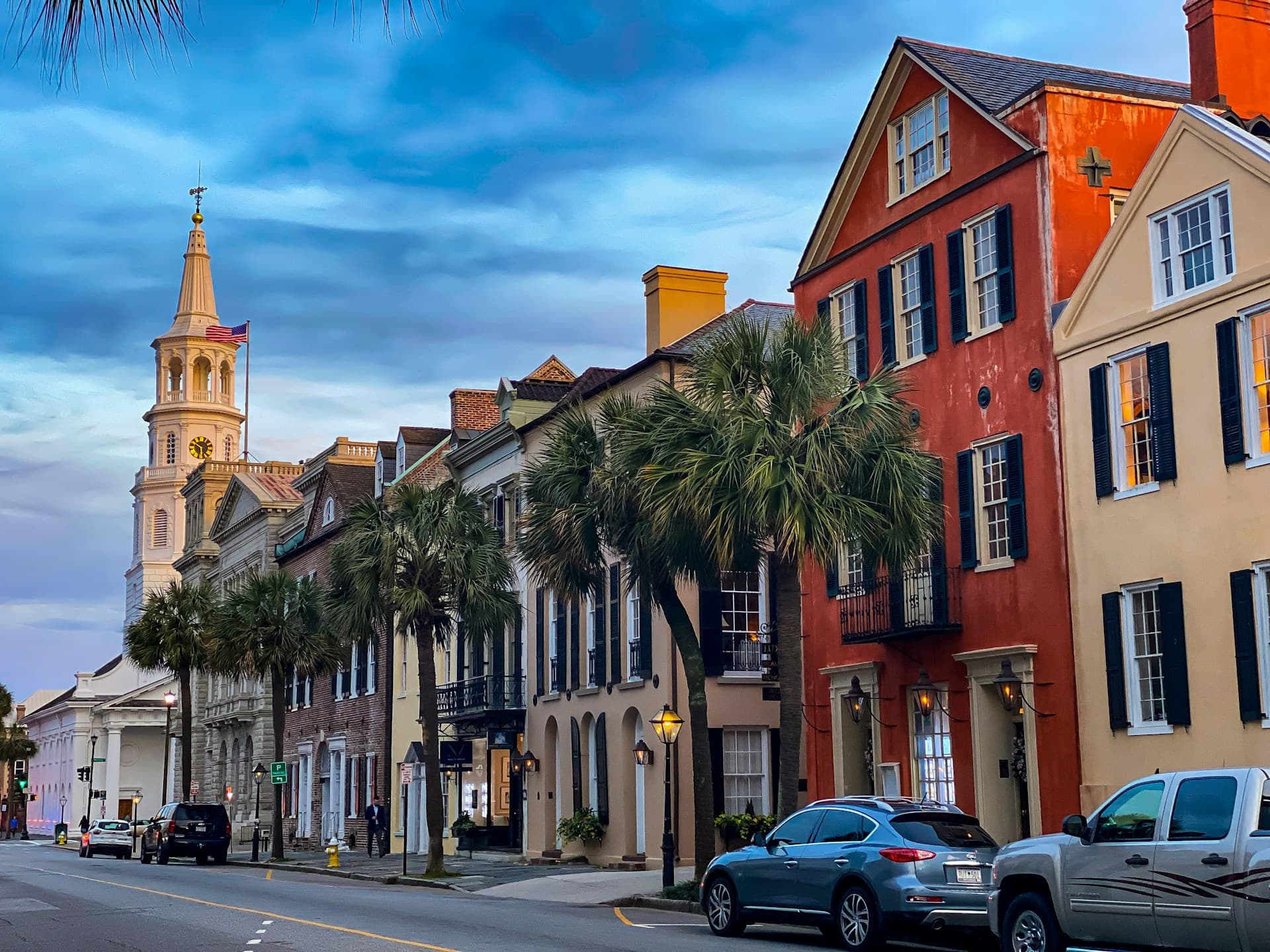
Old Village: Mount Pleasant's original neighborhood
Old Village is the historic core of Mount Pleasant — a roughly 37-block waterfront neighborhood on Charleston Harbor and Shem Creek, assembled from five English settlements laid out between 1766 and 1853. Roughly 2,312 homes sit inside the broader Old Village footprint, spanning restored 18th- and 19th-century buildings, 1940s cottages, 1960s brick ranches, and contextual new construction. Median year built is 1969 on median lots near ~0.21 acres.
There is no neighborhood-wide homeowners association (HOA). The local Old Village Historic District, established in 1979, is written into the Town of Mount Pleasant zoning code, and every exterior change is reviewed by the Historic District Preservation Commission (HDPC). The National Register Historic District has been listed since March 30, 1973 and covers about 30 of the neighborhood's 37 blocks. Two pocket sub-developments — Old Village Landing and Old Village at Ravenel — carry their own light-touch covenants.
Quick Facts
- Location: Mount Pleasant, SC — Charleston Harbor & Shem Creek waterfront
- Total homes: ~2,312 on median ~0.21-acre lots; median year built 1969
- Price range: ~$1.1M – $6M+ (townhouses from ~$590K; single-family median ~$2.05M)
- Home styles: Restored 18th–19th century, 1940s cottages, 1960s brick ranch, contextual new construction
- Vibe: Historic harbor village, no HOA, walkable Pitt Street
- Year founded: 1803 (James Hibben layout); constituent villages back to 1766
- HOA fee: None neighborhood-wide (Old Village Landing ~$300/yr; Old Village at Ravenel varies)
- Historic review: Local Old Village Historic District + HDPC review on all exterior changes; National Register-listed since March 30, 1973
- Schools: Mount Pleasant Academy, Moultrie Middle, Lucy Garrett Beckham High
- Flood & wind: Parcel-by-parcel mix of FEMA Zones VE, AE, and X on the flood-zone layer effective January 29, 2021; Wind Pool-eligible (Zone 2 core, Zone 1 at the marsh edge)
- Distance to downtown Charleston: ~5 miles / ~10 min via Ravenel Bridge
- Walk / Bike / Transit: 40 / 40 / 0 — car-dependent to somewhat walkable
What sets Old Village apart from other Mount Pleasant neighborhoods?
Old Village is the one Mount Pleasant neighborhood that pairs pre-20th-century origins, a walkable commercial strip on Pitt Street, direct Charleston Harbor waterfront, and a governance layer based on historic-district review rather than an HOA. The district has been on the National Register since 1973, and the local historic overlay has regulated exterior change since 1979.
Five English villages, one neighborhood
The Old Village footprint pulled together five separate antebellum settlements. Jonathan Scott laid out Greenwich Village in 1766 after purchasing the tract the previous year. Andrew Hibben bought the land south of Shem Creek in 1770 and obtained the ferry charter that became the Hibben Ferry Tract. James Hibben purchased Mount Pleasant Plantation in 1803 and surveyed 35 village lots that same year — the core street grid still in use. Charles Jugnot and Oliver Hilliard developed Hilliardsville around Alhambra Hall in 1847. Lucasville was platted June 5, 1853, as part of Mount Pleasant.
That layered origin is why Old Village still reads as a collection of micro-neighborhoods rather than a single planned community. Grid orientations, lot widths, and architectural periods shift depending on which village a block came from.
The oldest house on the block
The Hibben-McIver House at 111 Hibben Street was built c. 1759 — the oldest surviving home in the district. The original owner was Jacob Motte, then Public Treasurer of South Carolina, and the house sat at "the center of Mount Pleasant Plantation." After the May 1780 fall of Charleston the home served as British headquarters for the area. General William Moultrie — held as a paroled prisoner of war at Haddrell's Point, not locked inside the house — met Cornwallis and General Patterson in its upstairs drawing room during a June 1780 parley.
Ten National Register of Historic Places (NRHP) contributing resources sit inside the district: nine buildings plus one site (the Confederate Cemetery). The buildings are Mount Pleasant Presbyterian Church (1847), St. Andrew's Episcopal Church (1857, 440 Whilden), Mount Pleasant Seventh-Day Adventist Church (1901), the Old Court House (1884, 311 King — also independently listed), the Hibben-McIver House (c. 1759, 111 Hibben), Skipper's View (c. 1801, 101 Venning), Captain Peter Lewis House (c. 1855, 209 Live Oak), Tew-Coleman House (shortly after 1850, 226 Bennett), and the house at 200 Bank Street.
Organic, not engineered
Most of the texture buyers notice — an 1850s cottage next to a 1960s ranch next to a 2023 custom build — is the direct result of 220 years of piecemeal development. Live oaks draped with Spanish moss, curved sidewalk-lined streets, and the district's distinctive cast-concrete street signs span every era. The Pitt Street trolley line ran roughly 1898–1927 and is why the Pitt Street commercial district exists at all, and the Ben Sawyer Bridge replacement shifted the neighborhood's identity from isolated summer retreat to year-round community with beach access.
How much do homes cost in Old Village?
Homes in Old Village trade from roughly $1.1M for the smallest cottages and townhouses to $6M+ for waterfront estates with deepwater docks. Trailing-12-month median sale price runs near $1.54M across the broader footprint; single-family median sits closer to $2.05M at ~$876 per square foot.
Pricing by tier
| Tier | Typical price | What it buys | Notes |
|---|---|---|---|
| Entry / budget | ~$590K – $1.1M | Townhouse or small interior cottage | Townhouse median ~$590K; single-family below $1M is rare |
| Mid-range | ~$1.3M – $2.5M | 3–4 bedroom interior or near-core home, ~1,500–2,500 sqft | Most trade volume sits here |
| Premium | ~$2.5M – $4M | Renovated historic home or recent construction on a premium lot | Includes Live Oak Drive marsh-front and Pitt Street blocks near the bridge |
| Waterfront / trophy | ~$4M – $8M+ | Harbor-front estate with private dock and pool | Ceiling runs up to ~$8M; harbor-front estates on larger lots trade at the top of the range |
Seller's or buyer's market?
Roughly balanced, tilted slightly to sellers. Trailing-12-month signals across the broader footprint: ~55 days on market (vs ~56 nationally), ~4.2 months of supply, and ~1% year-over-year median sale price growth. Median change from first list price is roughly 7%. Single-month sales inside the formal Old Village Historic District boundary run much higher — around $3.09M median with an 18.3% year-over-year move — because high-end harbor sales dominate that narrower footprint. Plan against the trailing-12-month, broader-footprint figure.
Tear-down economics
A real pattern across 2023–2026: mid-century ranches on quarter-acre-plus lots trade for land value and get replaced with contextual new construction. By 2023, tear-down-ready lots under $1M had become rare, and the 2025–2026 market has followed through — a 1450 Barbara Street parcel, for example, has traded recent activity around $3.7M as a new custom build on a 0.21-acre lot.
That economic logic has driven a proposed Town of Mount Pleasant "Old Mount Pleasant" build-and-renovation ordinance, which would constrain the size and scale of main houses and the height and location of accessory structures. Residents split between "fishbowl" concerns about massing and privacy loss and council-side concerns about homeowner flexibility and property rights.
Selling in Old Village?
We track Old Village inventory, buyer demand, and pricing shifts. Get a confidential valuation and a practical strategy for timing, prep, and pricing.
What is it like to live in Old Village?
Old Village blends walkable commercial frontage on Pitt Street, direct Shem Creek and Charleston Harbor waterfront access, a golf-cart-and-bicycle culture, and a civic rhythm where the HDPC hearing calendar, the McCants Drive drainage project, and the Alhambra Hall event schedule all matter week to week.
Pitt Street's working commercial strip
The Pitt Street micro-district anchors the neighborhood's day-to-day commercial life:
- Pitt Street Pharmacy — founded 1937; soda fountain and compounding pharmacy; featured in The Notebook, Outer Banks, and The Ripping
- Old Village Post House — three-story boutique inn and fine-dining restaurant at 101 Pitt Street, reopened by the Basic Kitchen team
- Leeah's — wine shop that opened in 2020 with a 25-guest tasting capacity
- Rudi's Old Village Wine Shop — Thursday–Friday 5–8 PM happy hour
- Out of Hand — gifts, florist, and antiques
- Studio Shoppe Charleston, Swish Hair Studio, Old Village Gym (24/7 access), Mylk Bar nail salon — round out the strip
- Recurring events: Holiday Streetfest (December, free), Galentine's Night Out ($25–30), Sundae Funday (Sundays 3–5 PM)
Shem Creek and Charleston Harbor access
The neighborhood's northern boundary runs along Shem Creek — Charleston's working shrimp-and-oyster waterfront. Residents can walk or golf-cart to Saltwater Cowboys, Red's Ice House, and Tavern & Table at Shem Creek. The Mount Pleasant Farmers Market runs Tuesdays 3:30–7 PM from April through September nearby on Coleman Boulevard.
Parks and landmarks
- Pitt Street Bridge / Bridge Park — the original 1898 trolley crossing, now a ~3-mile round-trip walking and biking path with marsh views to the Ravenel Bridge, Fort Sumter, and Sullivan's Island. A July 2025 ribbon-cutting followed improvements that added indigenous landscaping, slope stabilization, a kayak launch, and upgraded parking including dedicated golf-cart and accessible parking spaces.
- Alhambra Hall — a former ferry terminal with hardwood floors, vaulted ceilings, and wraparound southern porches; the neighborhood's primary event venue.
- Alhambra Playground, Ocean Walk at Pitt Street Bridge Park, Shem Creek Park, Groves Playground, Julian Weston Park Tennis Courts, and James B. Edwards Passive Park — the public-park inventory within or adjacent to the district.
- Haddrell's Point Tackle (established 1983) and Marsh View Fishing Charters — working waterfront amenities.
The unfiltered texture
Old Village is not a friction-free neighborhood. The current civic debates:
- Mini-roundabout pilot at McCants and Center. Speeding on interior streets is a shared concern; the open civic question before the Transportation Committee is whether mini-roundabouts are the right device for these streets, versus speed humps and stepped-up enforcement.
- Parking and curbspace. The December Pitt Street Christmas market pulls heavy visitor parking onto Bennett and Venning, where homeowners use planters, cones, and tape to hold curbspace. Sight-distance at Pitt and Morrison is a separate active item before the Transportation Committee.
- Golf carts. Golf carts are the preferred local mode — the 2025 Pitt Street Bridge improvements explicitly added golf-cart parking — and underage drivers operating carts on the roadway is an active enforcement item for Mount Pleasant Police in the neighborhood.
- Construction fatigue. Royall Avenue drainage work ran October 2021 through completion, Center Street at Edwards Drive saw repeated closures in 2022, and the Edwards Park basin is on a stopgap pump-truck response while grant funding remains unresolved. The tradeoff is rarely "don't do the project" — it is duration, visibility, and uncertainty.
- Tourism spillover. Outer Banks filming on Pitt Street and continued destination framing of the Pitt Street Bridge corridor drive visitor traffic that residents value (local commerce) and dislike (curb occupation) in the same breath.
Considering Old Village?
We can help you compare sections, flood exposure, schools, and the tradeoffs that do not show up in the listing photos.
How far is Old Village from downtown Charleston?
Old Village sits about 5 miles and roughly 10 minutes from downtown Charleston via the Arthur Ravenel Jr. Bridge, and about 5 minutes from Sullivan's Island beach via the Ben Sawyer Bridge.
| Destination | Drive time | Route notes |
|---|---|---|
| Downtown Charleston | ~10 min | Coleman Blvd → US-17 → Ravenel Bridge |
| Sullivan's Island beach | ~5 min | Ben Sawyer Bridge |
| Isle of Palms beach | ~15 min | IOP Connector |
| Charleston International Airport | ~30 min | US-17 → I-526 |
| Shem Creek restaurants | Walking / cart | Northern boundary of the district |
| Pitt Street shops | Walking / cart | Inside the neighborhood |
Two routing specifics matter before closing. First, Mount Pleasant evacuation routing for the Old Village area uses Coleman Boulevard to US-17, not the Isle of Palms Connector — the Connector is a separate East Cooper route. Second, the Ben Sawyer Bridge is a Charleston-area exposed bridge subject to county high-wind protocols (25/30/40 mph thresholds), which matters for beach commutes during strong frontal systems and during tropical events.
What schools serve Old Village in Mount Pleasant?
Old Village is zoned for Mount Pleasant Academy (PreK–5), Moultrie Middle School (6–8), and Lucy Garrett Beckham High School (9–12), all in the Charleston County School District.
| Level | School | Address | Niche | Notes |
|---|---|---|---|---|
| Elementary | Mount Pleasant Academy | 605 Center Street | A | Sits inside Old Village |
| Middle | Moultrie Middle | 645 Coleman Blvd | A | Experiential-learning programs focused on Shem Creek and Charleston Harbor |
| High | Lucy Garrett Beckham | 1560 Mathis Ferry Rd | A | Opened 2020; Old Village is zoned to Lucy Beckham — verify any specific address in the CCSD School Look-Up tool |
The most recent CCSD boundary changes in Mount Pleasant (late 2022–2023) adjusted elementary and middle assignments in the Carolina Park area, not Old Village. No 2024–2026 board-approved boundary changes affect Old Village's high school assignment.
Mount Pleasant Academy sits at 605 Center Street, inside the district, so many students walk, bike, or ride as passengers on golf carts. Private alternatives in the area include Charleston Day School, Porter-Gaud, and Coastal Christian Preparatory. Verify any specific address through the CCSD School Look-Up tool.
What is the HOA fee in Old Village?
There is no neighborhood-wide homeowners association (HOA) and no HOA fee for Old Village's historic core. The operative governance layer is the local Old Village Historic District, written into the Town of Mount Pleasant zoning code, and every exterior change inside that district is reviewed by the Historic District Preservation Commission.
The Historic District Preservation Commission (HDPC)
The commission — previously known as the Old Village Historic District Commission (OVHDC) — now operates as the Historic District Preservation Commission (HDPC), a volunteer body appointed by Town Council. Meetings generally run on the second Monday of each month; confirm the current schedule, meeting time, and location on the HDPC page at tompsc.com. Current HDPC guidelines supersede the 2001 Handbook and an earlier January 2020 draft revision.
Certificate of Appropriateness (COA) process
Applications run through the Town's online permit portal (OPAL) roughly four weeks before the hearing. Staff reviews submissions, requests clarifications, and issues stamped plans on approval — and those stamped plans unlock the standard Mount Pleasant building permit. A published Town fee schedule applies to COA applications (minor repairs, additions, demolition, new construction, accessory structures, and appeals); verify current amounts on the Town of Mount Pleasant fee schedule before filing. Interior renovations are outside HDPC jurisdiction.
What routinely gets pushback
The friction points HDPC sees most often, and the same points at issue in the separate "Old Mount Pleasant" build-and-renovation ordinance:
- Massing and scale. New construction that maximizes lot coverage and height relative to neighbors, producing the "fishbowl" privacy complaint.
- Setbacks relative to neighbor context. Adjacent structures, not just code minima, effectively set the expected setback.
- Exterior materials and detailing that diverge from the district's historic vocabulary.
Pocket sub-developments (the two exceptions)
Two pocket sub-developments inside the broader Old Village footprint carry their own covenants:
- Old Village Landing — a covenanted sub-development under a 1993 recorded declaration. The fee runs ~$300/year, with trash service covered and no pool, clubhouse, gate, or master insurance. Functionally a light-touch, covenant-enforcement HOA.
- Old Village at Ravenel — a 14-lot neighborhood with protective covenants on a private road. Current fee figures vary; confirm the active fee and its billing cadence in the resale package before closing.
Neither pocket regime alters HDPC jurisdiction over exterior change where the pocket sits inside the local historic-district boundary.
What will my property taxes be in Old Village?
The 2025 Charleston County reassessment raised Mount Pleasant property values 10.4% above 2024, with town-total collections up 15.3% and taxable assessment up 13.8%. The combined 2025 tax rate for Mount Pleasant properties is 260.4 mills.
2025 tax rate breakdown — Town of Mount Pleasant
| Component | Mills |
|---|---|
| Countywide | 216.1 |
| Town of Mount Pleasant (34.7 operating + 9.6 bond) | 44.3 |
| Combined total | 260.4 |
About 59% of Mount Pleasant's 2025 assessed total sat in the 4% primary-residence category, and 41% sat in the 6% non-primary category.
How the 4% vs 6% classification works
South Carolina splits property tax into two classifications, and the difference is substantial:
- 4% legal residence — owner-occupied primary home on up to 5 contiguous acres. School-operating taxes are exempted, and you apply through the county assessor. Renting the home more than 72 days in a year disqualifies the 4% status.
- 6% non-primary — second homes, vacation homes, investment rentals, and most LLC-owned homes. The full tax rate applies, with no school-operating exemption.
On the same home, the 6% bill commonly runs three times the 4% bill or more, because the higher classification ratio and the school-operating taxes stack.
Worked example — $1.5M Old Village home
- 6% non-primary: Roughly $23,400 in gross tax before local-option sales tax (LOST) credits of about $1,800, for an estimated $21,650 before the county solid-waste fee.
- 4% legal residence: The effective bill runs dramatically lower than the 6% figure — often less than a third — because the school-operating exemption is the largest single component of the spread. Ask the county assessor or your closing attorney for an exact first-year estimate on a specific address.
The tax reset at closing
Charleston County resets a home's taxable value at sale — a step called an Assessable Transfer of Interest. The prior owner's 15% reassessment cap is removed, and in the next tax year the home is reassessed to 100% of the sale price or current fair-market value. A new owner should model the first year's tax against the purchase price, not the seller's prior bill. This matters in Old Village specifically because long-held family homes with decades of capped assessment are common, so a seller's tax bill can run two to three times lower than the first-year bill a new owner will see.
Charleston County mailed 2025 reassessment notices August 20, 2025, with a November 18, 2025 objection deadline.
What flood zone is Old Village in?
Old Village is a parcel-by-parcel mix of FEMA Zones VE, AE, and X — not a single-zone neighborhood. The current Flood Insurance Rate Map (FIRM) panels covering the area — 45019C0517K (west) and 45019C0536K (east) — took effect January 29, 2021 and are still the operative panels.
Zone pattern by sub-area
| Sub-area | Typical zone | Notes |
|---|---|---|
| Waterfront / immediate tidal fringe (harbor and creek edges) | VE and lower-elevation AE | Wave-action requirements; higher required finished-floor elevations |
| Southern and central interior | Mix of AE and X | A Harbour Watch parcel sits in AE with a base flood elevation of 11 feet |
| Higher central / northern interior | More X, with AE pockets where drainage is poorer | Mid-block Church Street reads Zone X |
| Eastern edge toward Cove Inlet and marsh | Lot-specific; AE-to-VE transitions possible | Inlet Drive, Simmons Pointe / Old Village Landing side |
The map changes block by block within a few hundred feet. Pull the flood-map printout for a specific address before getting quotes.
Wind Pool coverage (all of 29464 is eligible)
The entire 29464 ZIP is eligible for coverage through the South Carolina Wind and Hail Underwriting Association (the state's Wind Pool). Charleston County Wind Pool territory splits into Zone 1 (east of the Intracoastal Waterway's west bank) and Zone 2 (between U.S. Highway 17 and the Intracoastal Waterway). The traditional Old Village core — Pitt, Church, Center, Royall, Whilden, Bennett, King, Morrison, Venning, and Haddrell streets — reads as Zone 2. The eastern marsh-edge corridor (Simmons Pointe, Old Village Landing, Inlet Drive, and the Barbara / Majore / McCants blocks approaching the marsh) reads as Zone 1 candidates. The final zone determination is inspection-driven, and no part of Old Village falls outside Wind Pool territory.
The Wind Pool's current rating manual took effect November 1, 2025 and raised base pricing on dwelling coverage from the prior action. Actual address-level premiums depend on zone, deductible, and coverage limit, and require a live quote.
Deductible mechanics (the surprise cost)
Coastal South Carolina homeowners policies use percentage-based deductibles for wind, hail, and named-storm claims — commonly 1% to 10% of the home's dwelling coverage, typically landing in the 2–5% range. The deductible may apply per event, per season, or per calendar year depending on the carrier. On dwelling coverage, that translates to:
| Deductible | $1.5M dwelling coverage | $3.0M dwelling coverage |
|---|---|---|
| 1% | $15,000 | $30,000 |
| 2% | $30,000 | $60,000 |
| 5% | $75,000 | $150,000 |
| 10% | $150,000 | $300,000 |
Budget for the deductible, not just the premium. A $3M waterfront home with a 5% named-storm deductible means the owner pays the first $150,000 of damage on a single qualifying event.
Flood insurance workflow
The National Flood Insurance Program (NFIP) prices flood by address and building characteristics, not by zone alone, under its current pricing rules. Wind Pool coverage for full-value wind claims requires flood coverage regardless of whether the home sits in a federally designated high-risk flood area. The practical insurance workflow before closing:
- Pull the parcel flood map from FEMA's Map Service Center.
- Get a current elevation certificate.
- Confirm Wind Pool territory and zone.
- Get a live homeowners quote from a standard carrier.
- Get a live Wind Pool fallback quote.
- Get live NFIP and private-flood quotes.
Premiums for representative $1.5M and $3M Old Village addresses come from that live quote stack. Flood pricing under current NFIP rules is set per address and per building, so quotes on a nearby parcel will not predict yours.
Drainage and nuisance flooding
Parts of Old Village see recurring tidal and rain-event flooding unrelated to hurricanes, driven by topography and stormwater capacity rather than FEMA-mapped flood risk. Current drainage program status:
| Project | Status | Scope | Notes |
|---|---|---|---|
| Royall Avenue Basin | Completed | First major Old Village basin | Town-funded contract ~$9.69M; 13,000 ft of pipe, 177 outlets, 10-year storm design |
| Ben Sawyer / Kincaid Basin | Under construction | 105 acres | ~$9M contract awarded September 2025; posted completion June 1, 2026 |
| Edwards Park Basin | Designed, permitted, funding stalled | 138 acres, 434 parcels | ~$8.8M project; original $5.67M federal Building Resilient Infrastructure and Communities (BRIC) grant canceled; town pursuing Hazard Mitigation Grant Program (HMGP) funding through SCEMD (South Carolina Emergency Management Division) |
| Saltgrass / Alhambra / Dovre Basins | In funding pursuit | 167 acres, 565 properties | ~6,245 linear feet of pipe, 72 structures, plus tidal control |
| McCants / Barbara / Majore corridor | Active construction | East-side strip | Partial McCants Drive closure began April 6, 2026 |
Recurring nuisance-flooding hotspots include Pitt Street at Ferry Street (the Edwards Park low area), the Haddrell's Point and Shem Creek accessibility edge during extreme tides, and the historic Freeman Street low spot that floods regularly because of topography and lacks a standalone capital project. A property in the completed Royall Avenue basin carries a materially different rain-event risk profile than one in the stalled Edwards Park basin, even where both sit in Zone X.
Can I short-term rent a home in Old Village?
Mount Pleasant caps short-term rental (STR) permits at 400 town-wide, and that cap has sat full. Old Village is not carved out of the town cap, and HDPC does not separately regulate rental use — STR permitting is a town-level program governed by the Town of Mount Pleasant short-term rental ordinance.
Key rules to check before buying
- Cap: 400 permits town-wide; waitlist via email to
str@tompsc.comwith property address, owner name and contact, and dwelling type. A Certificate of Occupancy is required before a property can join the waitlist. - Primary-residency requirement for partial-home rentals: If you're renting part of your home or a secondary unit on the property — an accessory dwelling unit (ADU) — either the main house or the ADU must be the owner's primary residence. Town accessory-use rules cap how many guests an ADU can host.
- Permits do not transfer at sale: An existing STR permit does not carry over to a new owner. A new owner must submit a new application and pay the fee. South Carolina state law does require a new owner to honor pre-scheduled rentals for 90 days after closing.
- Fees: A published permit-fee schedule applies, with different rates for part-time or bedroom-only rentals versus full-time whole-house and ADU rentals; a Town business license is also required. Verify current amounts in the Town's fee schedule before you budget.
- Enforcement: The Town ordinance carries monetary penalties for operating without a permit and for repeat violations, plus a ban on applying again after a conviction for unpermitted operation.
- 2025 enforcement posture: The Town has actively denied renewals for existing operators who failed the ordinance's annual minimum-use threshold.
- 2025 platform settlement: The Town reached a settlement with major short-term rental platforms in early 2025 over accommodations-tax and business-license collection.
Verify the current ordinance text at the Town code portal and the Town's STR program page before closing on any purchase where rental income is part of the plan. Confirm specific fee amounts and the minimum-use threshold against the posted ordinance and current fee schedule during due diligence.
Is Old Village a good place to live?
Old Village fits buyers who want layered history, harbor and creek waterfront, a walkable commercial district, and a governance layer based on preservation rather than HOA rules — and who price in the flood, wind, and carrying-cost realities that come with the location.
The tradeoffs, named directly
- Budget floor. Townhouses start around $590K; single-family essentially starts in the mid-$1Ms. Below that, inventory is thin.
- Historic-district review. HDPC approval is required on every exterior change. The process is predictable, but it is not optional and it adds time. Buyers who want total renovation freedom should look elsewhere.
- Flood and wind exposure. A parcel's FEMA flood zone, Wind Pool zone, and drainage-basin status materially change the carrying cost of the same square footage. Run live quotes before removing the due-diligence period.
- Tax reset at closing. Charleston County removes the seller's 15% assessment cap at sale, so model the first year's tax against the purchase price — not the seller's prior bill.
- No short-term rental workaround. The 400-permit cap, non-transferability at sale, and primary-residency rules limit the income-property thesis.
- Active public-works footprint. Edwards Park, McCants / Barbara / Majore, Ben Sawyer / Kincaid, and the adjacent drainage program will keep road closures and construction visibility on the calendar through 2026.
- Inconsistency as a feature. An 1850s restored home next to a 1960s ranch next to a 2023 custom build is the neighborhood's texture. Buyers who want designed uniformity will be frustrated.
How Old Village compares to I'On
| Factor | Old Village | I'On |
|---|---|---|
| Origin | Organic; five English villages assembled 1766–1853 | Planned New Urbanism; master plan from the late 1990s |
| Homes | Historic restored, 1940s cottages, 1960s ranch, new build | Charleston single, colonial revival, Lowcountry vocabulary |
| Waterfront | Charleston Harbor + Shem Creek frontage | Hobcaw Creek and marsh |
| Governance | No HOA; local Historic District + HDPC review | HOA; Architectural Review Board |
| Commercial | Pitt Street district (evolved from 1937 onward) | Small internal commercial nodes |
| Best for | Buyers prioritizing authentic history, harbor access, walkable Pitt Street | Buyers prioritizing designed consistency and internal amenities |
Tour both — the two neighborhoods fit different buyer priorities, and the right one is usually obvious by the second visit.
FAQ
Is Old Village in a flood zone?
Old Village is a parcel-by-parcel mix of FEMA Zones VE, AE, and X under the Flood Insurance Rate Map effective January 29, 2021. Harbor and creek edges concentrate in VE and lower-elevation AE; southern and central interior blocks mix AE and X; higher central and northern interior leans X with AE pockets where drainage is poorer. The entire 29464 ZIP is eligible for coverage through the South Carolina Wind and Hail Underwriting Association (the state's Wind Pool), with the core reading as Zone 2 and the marsh-edge east side as Zone 1 candidates. Pull the parcel flood-map printout and run live National Flood Insurance Program, private-flood, and Wind Pool quotes before closing.
Is there an HOA in Old Village?
There is no neighborhood-wide homeowners association (HOA) or HOA fee. Two pocket sub-developments carry their own regimes: Old Village Landing, which runs about $300 a year and traces to an April 13, 1993 recorded declaration, and Old Village at Ravenel, a 14-lot covenanted subdivision on a private road where current fee figures vary — confirm the number in the resale package. The governance that applies district-wide is Historic District Preservation Commission (HDPC) review of all exterior changes.
How does the Historic District Preservation Commission work?
Every exterior change inside the local Old Village Historic District needs a Certificate of Appropriateness from the Historic District Preservation Commission (HDPC, formerly the Old Village Historic District Commission, or OVHDC). Applications run through the Town's online permit portal (OPAL) roughly four weeks before the hearing; the commission generally meets on the second Monday of each month at the Mount Pleasant Municipal Complex — confirm the current schedule on the HDPC page at tompsc.com. Current guidelines supersede the 2001 Handbook and an earlier January 2020 draft. Approved plans unlock the standard building permit. Interior renovations do not require HDPC review.
What schools serve Old Village?
Old Village is zoned for Mount Pleasant Academy (PreK–5, 605 Center Street — inside the neighborhood), Moultrie Middle School (6–8, 645 Coleman Blvd), and Lucy Garrett Beckham High School (9–12, 1560 Mathis Ferry Rd). All three carry Niche grade A. No 2024–2026 Charleston County School District (CCSD) boundary changes affected Old Village's high school assignment. Verify any specific address through the district's school look-up tool.
Can I rent my Old Village home on Airbnb?
Mount Pleasant caps short-term rental (STR) permits at 400 town-wide under the Town's short-term rental ordinance, and the cap has sat full. Permits do not transfer with a sale; a new owner must apply fresh. Primary-residency rules apply when renting part of a home or a secondary unit (an accessory dwelling unit, or ADU). A 2025 enforcement push denied renewals for operators who failed the ordinance's annual minimum-use threshold. Verify current rules, fees, and waitlist status with the Town before counting on any rental income.
What will my property taxes be in Old Village?
The 2025 combined tax rate for Mount Pleasant properties is 260.4 mills (216.1 countywide plus 44.3 town). A $1.5M home taxed at the 6% non-primary classification generates roughly $23,400 in gross tax before local-option sales tax (LOST) credits of about $1,800 and the county solid-waste fee — estimated at roughly $21,650 before solid waste. The 4% legal-residence classification uses a lower assessment ratio and exempts school-operating taxes, producing a dramatically lower bill — often less than a third of the 6% amount. A sale triggers a reset (called an Assessable Transfer of Interest) that removes the prior owner's 15% cap, so new owners should model the first year's tax against the purchase price, not the seller's bill.
How does Old Village compare to I'On?
Old Village evolved organically over 220 years from five English villages, has no HOA, carries a historic-district review layer, and fronts Charleston Harbor and Shem Creek. I'On was planned as a New Urbanist community in the late 1990s, carries a formal HOA and Architectural Review Board, and fronts Hobcaw Creek. Old Village buyers take organic inconsistency in exchange for authenticity and harbor access; I'On buyers take designed consistency and internal amenities.
Useful Resources
Official
- Town of Mount Pleasant — Historic District Preservation Commission — meeting schedule, current guidelines, application materials
- Charleston County Auditor — 2025 Millage Card — the finalized Mount Pleasant tax rate and local-option sales tax credit factors
- Charleston County Assessor — reassessment notices, tax reset at sale, and 4% legal-residence application
- FEMA Flood Map Service Center — parcel-specific flood-map printout lookup
- Charleston County School District — attendance-zone look-up
- Town of Mount Pleasant — Code of Ordinances — the Old Village Historic District rules, Historic District Preservation Commission administration, and the Town's short-term rental ordinance